




Marketdash

Trump's 10% Credit Card Rate Cap Could Backfire: Experts Warn of Vanishing Rewards and Tighter Credit

MarketDash Editorial Team

holding credit cards
President Trump's proposal to cap credit card interest rates at 10% might sound like a win for consumers, but industry experts warn the policy could actually eliminate rewards programs, force airlines into crisis mode, and lock millions of Americans out of credit markets entirely.

Get American Airlines Group Alerts

Weekly insights + SMS alerts

President Donald Trump's push for a nationwide 10% cap on credit card interest rates is making headlines, but the people who actually understand how consumer credit works are sounding alarm bells. According to experts who spoke with MarketDash, this seemingly consumer-friendly policy could accidentally reshape entire industries and leave vulnerable borrowers worse off than before.

Your Travel Rewards Might Disappear

Here's the counterintuitive part: A rate cap designed to help everyday Americans could end up making credit cards worse for most people. Dave Grossman, founder of Your Best Credit Cards, explains that when banks can't price risk properly through interest rates, they start looking for other ways to make money or cut their losses.

The result? A "K-shaped" divergence where wealthy customers with premium cards get showered with even better perks, while everyone else watches their rewards evaporate. "You could imagine a bifurcation of rewards where they get limited to those with premium cards and premium annual fees," Grossman told MarketDash.

Translation: If you're carrying a no-annual-fee cashback card, those rewards you've been collecting might not survive a rate cap. Banks would shift their focus to high-net-worth customers who can afford $500-plus annual fees, leaving mass-market cardholders with bare-bones products.

Airlines Have a Serious Problem

The credit card situation gets even messier when you realize how deeply airlines have woven themselves into the rewards ecosystem. Grossman puts it bluntly: "Without the sale of miles to banks, airlines could need a bailout."

That's not hyperbole. Airlines have essentially turned their loyalty programs into profit centers that sometimes generate more reliable income than actually flying people around. The math is staggering when you look at the numbers.

Delta Air Lines (DAL) pulled in roughly $2 billion from its American Express partnership in Q3 2025 alone, representing a 12% jump year-over-year. Nearly all of that came from spending on Delta co-branded credit cards, not from people actually buying plane tickets.

American Airlines (AAL) was sitting on about $3.7 billion in loyalty program liability as of September 30, reflecting the massive volume of miles they've issued through credit card partnerships and the future revenue those relationships represent.

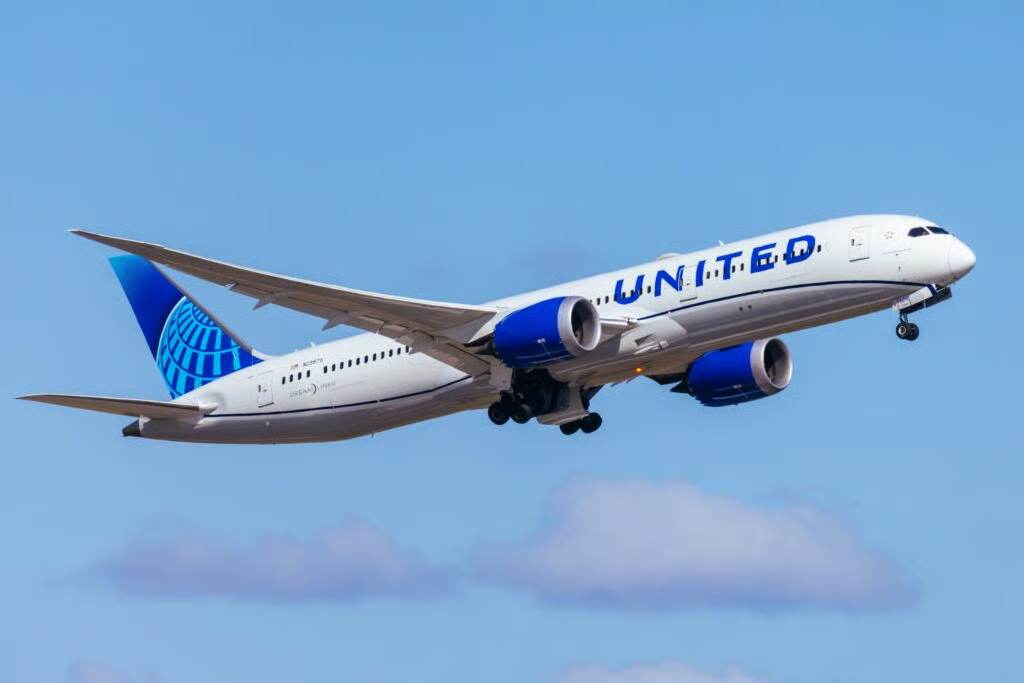
United Airlines (UAL) reported $3.49 billion in "other revenue" largely driven by co-branded card spending and loyalty partnerships, according to their annual filing. These programs have become essential non-ticket revenue sources that keep the airlines financially healthy.

If a rate cap squeezes banks' ability to fund lucrative rewards programs, those multibillion-dollar partnerships could crumble. And airlines that have become dependent on that steady cash flow would suddenly have a serious balance sheet problem.

Get American Airlines Group Alerts

Weekly insights + SMS (optional)

The People It's Supposed to Help Get Hurt Most

John Garner, founder and CEO of Odynn, says the borrowers Trump presumably wants to protect—those with imperfect credit scores—would actually bear the brunt of the damage. "A 10% APR cap sounds great at first, but the downsides hit fast," Garner explained. "This isn't leveling the playing field—it's shrinking it."

The logic is straightforward: If banks can't charge interest rates that reflect the actual risk of lending to subprime borrowers, they'll simply stop issuing cards to those customers. Why take on the risk if you can't price it properly?

Jennifer Doss of CardRatings.com points out that restricting credit card access would actually hurt upward mobility by making it harder for consumers to build credit history. Worse, people who still need financing might get pushed toward shadier alternatives like payday loans that charge even higher effective rates and offer fewer consumer protections.

Mike Taiano from Moody's Ratings offers one caveat: Since Trump's proposal is for a temporary one-year cap rather than a permanent change, card issuers might not pull back quite as aggressively. But even a temporary disruption could have lasting consequences.

Price Controls Have a Bad Track Record

Economic policy experts are viewing this proposal through the lens of historical price control failures. "Government-imposed price controls do not work," said Thomas Aiello, Senior Director of Government Affairs at the National Taxpayers Union. When you artificially set prices below market rates, he warns, "it leads to shortages, squeezes the cost bubble toward some other portion of the economy, and imposes a deadweight cost on society."

The banking industry isn't thrilled either. Citigroup (C) outgoing CFO Mark Mason and JPMorgan Chase (JPM) CEO Jamie Dimon have both expressed disapproval of Trump's stance on rate caps.

Taiano from Moody's framed the proposal as "credit negative" for major card-issuing banks, explaining it would squeeze net interest income, slow loan growth, and reduce volume-based revenues. The exact impact would vary depending on each bank's specific business model and appetite for risk, but none of it looks particularly good.

The irony is almost perfect: A policy designed to help struggling Americans afford credit could end up taking credit away from them entirely, eliminating the rewards middle-class consumers enjoy, and potentially triggering a crisis in an unrelated industry that's become unexpectedly dependent on credit card economics. Sometimes good intentions and sound policy are two very different things.

Trump's 10% Credit Card Rate Cap Could Backfire: Experts Warn of Vanishing Rewards and Tighter Credit

MarketDash Editorial Team
holding credit cards
President Trump's proposal to cap credit card interest rates at 10% might sound like a win for consumers, but industry experts warn the policy could actually eliminate rewards programs, force airlines into crisis mode, and lock millions of Americans out of credit markets entirely.

Get American Airlines Group Alerts

Weekly insights + SMS alerts

President Donald Trump's push for a nationwide 10% cap on credit card interest rates is making headlines, but the people who actually understand how consumer credit works are sounding alarm bells. According to experts who spoke with MarketDash, this seemingly consumer-friendly policy could accidentally reshape entire industries and leave vulnerable borrowers worse off than before.

Your Travel Rewards Might Disappear

Here's the counterintuitive part: A rate cap designed to help everyday Americans could end up making credit cards worse for most people. Dave Grossman, founder of Your Best Credit Cards, explains that when banks can't price risk properly through interest rates, they start looking for other ways to make money or cut their losses.

The result? A "K-shaped" divergence where wealthy customers with premium cards get showered with even better perks, while everyone else watches their rewards evaporate. "You could imagine a bifurcation of rewards where they get limited to those with premium cards and premium annual fees," Grossman told MarketDash.

Translation: If you're carrying a no-annual-fee cashback card, those rewards you've been collecting might not survive a rate cap. Banks would shift their focus to high-net-worth customers who can afford $500-plus annual fees, leaving mass-market cardholders with bare-bones products.

Airlines Have a Serious Problem

The credit card situation gets even messier when you realize how deeply airlines have woven themselves into the rewards ecosystem. Grossman puts it bluntly: "Without the sale of miles to banks, airlines could need a bailout."

That's not hyperbole. Airlines have essentially turned their loyalty programs into profit centers that sometimes generate more reliable income than actually flying people around. The math is staggering when you look at the numbers.

Delta Air Lines (DAL) pulled in roughly $2 billion from its American Express partnership in Q3 2025 alone, representing a 12% jump year-over-year. Nearly all of that came from spending on Delta co-branded credit cards, not from people actually buying plane tickets.

American Airlines (AAL) was sitting on about $3.7 billion in loyalty program liability as of September 30, reflecting the massive volume of miles they've issued through credit card partnerships and the future revenue those relationships represent.

United Airlines (UAL) reported $3.49 billion in "other revenue" largely driven by co-branded card spending and loyalty partnerships, according to their annual filing. These programs have become essential non-ticket revenue sources that keep the airlines financially healthy.

If a rate cap squeezes banks' ability to fund lucrative rewards programs, those multibillion-dollar partnerships could crumble. And airlines that have become dependent on that steady cash flow would suddenly have a serious balance sheet problem.

Get American Airlines Group Alerts

Weekly insights + SMS (optional)

The People It's Supposed to Help Get Hurt Most

John Garner, founder and CEO of Odynn, says the borrowers Trump presumably wants to protect—those with imperfect credit scores—would actually bear the brunt of the damage. "A 10% APR cap sounds great at first, but the downsides hit fast," Garner explained. "This isn't leveling the playing field—it's shrinking it."

The logic is straightforward: If banks can't charge interest rates that reflect the actual risk of lending to subprime borrowers, they'll simply stop issuing cards to those customers. Why take on the risk if you can't price it properly?

Jennifer Doss of CardRatings.com points out that restricting credit card access would actually hurt upward mobility by making it harder for consumers to build credit history. Worse, people who still need financing might get pushed toward shadier alternatives like payday loans that charge even higher effective rates and offer fewer consumer protections.

Mike Taiano from Moody's Ratings offers one caveat: Since Trump's proposal is for a temporary one-year cap rather than a permanent change, card issuers might not pull back quite as aggressively. But even a temporary disruption could have lasting consequences.

Price Controls Have a Bad Track Record

Economic policy experts are viewing this proposal through the lens of historical price control failures. "Government-imposed price controls do not work," said Thomas Aiello, Senior Director of Government Affairs at the National Taxpayers Union. When you artificially set prices below market rates, he warns, "it leads to shortages, squeezes the cost bubble toward some other portion of the economy, and imposes a deadweight cost on society."

The banking industry isn't thrilled either. Citigroup (C) outgoing CFO Mark Mason and JPMorgan Chase (JPM) CEO Jamie Dimon have both expressed disapproval of Trump's stance on rate caps.

Taiano from Moody's framed the proposal as "credit negative" for major card-issuing banks, explaining it would squeeze net interest income, slow loan growth, and reduce volume-based revenues. The exact impact would vary depending on each bank's specific business model and appetite for risk, but none of it looks particularly good.

The irony is almost perfect: A policy designed to help struggling Americans afford credit could end up taking credit away from them entirely, eliminating the rewards middle-class consumers enjoy, and potentially triggering a crisis in an unrelated industry that's become unexpectedly dependent on credit card economics. Sometimes good intentions and sound policy are two very different things.