Sometimes the best trading opportunities come wrapped in panic. Right now, Bank of America Corp (BAC) finds itself caught in one of the stranger geopolitical dramas of recent memory—a dispute over Greenland that sent markets into a brief tailspin earlier this week. But here's the interesting part: the fear itself might be creating exactly the kind of contrarian setup that options traders dream about.
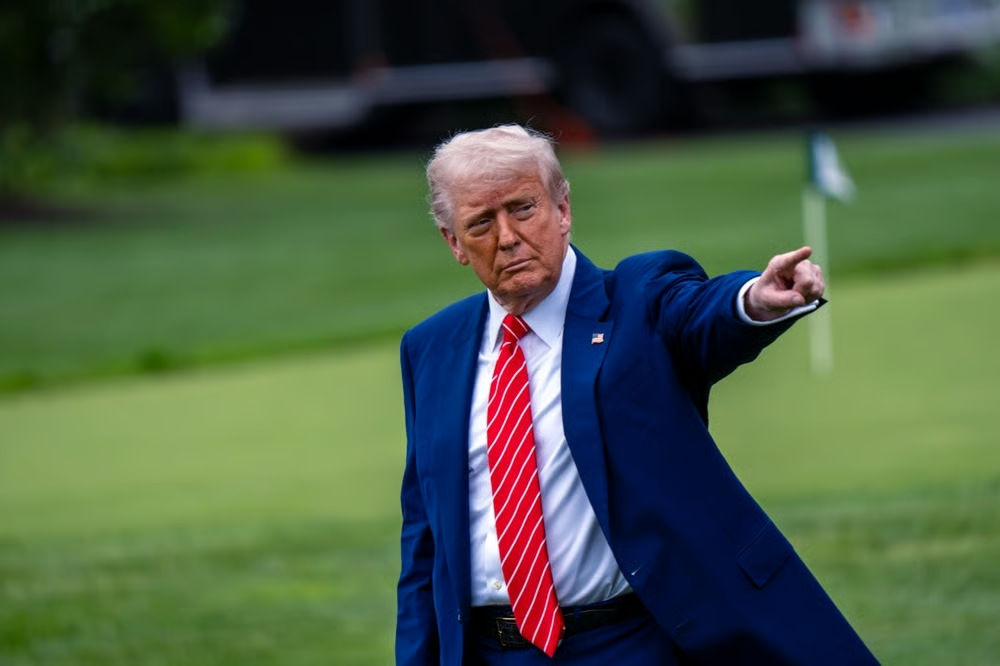
When markets reopened Tuesday after Martin Luther King Jr. Day, traders had to digest President Donald Trump's aggressive stance toward European allies. The president threatened an additional 10% tariff starting Feb. 1, with potential escalation to 25% by June if Greenland negotiations went sideways. The real kicker? He initially refused to rule out military force. Not exactly the kind of language that inspires confidence in financial stocks.
Bank of America, like most financial institutions with significant international exposure, took it on the chin. The stock dropped as investors processed the implications of a potential trade war with Europe and whatever "Greenland negotiations" might actually mean in practice.
But then something predictable happened. At the World Economic Forum in Davos, Trump clarified his position. Yes, Greenland remains a national security priority. Yes, negotiations must continue. But no, military action isn't on the table. It was a classic example of what some traders call the TACO trade—Trump Always Chickens Out. Someone apparently convinced the administration to dial back the rhetoric, and sure enough, the walk-back arrived within 24 hours.
The market responded positively to this clarification, and Bank of America caught a bid. But here's the thing: the recovery was relatively muted compared to the severity of the selloff. Fear still lingers in the air. And that fear, as it turns out, might be exactly what creates opportunity.
What the Options Market is Telling Us
To understand market sentiment, you need to look at volatility skew in the options chain. That's academic-speak for a simple concept: which side of the market is more expensive? Are traders paying up for calls (betting on upside) or puts (betting on downside or buying protection)?
For Bank of America options expiring Feb. 20, the answer is crystal clear. The put side is significantly inflated compared to calls. Traders are paying premium prices for downside protection or outright bearish bets. Everyone's worried about what happens if this geopolitical situation deteriorates further.
Does that mean Bank of America is doomed? Not at all. Smart money is intelligent, but it's not psychic. Even the sharpest traders in the room get caught off guard because markets don't care about consensus opinion. The market is the ultimate arbiter, and it does what it wants.
Using the standard Black-Scholes model, the market expects Bank of America to trade between $50.06 and $55.04 over this timeframe—roughly a 4.73% range from the current price. That's not particularly helpful if you're trying to make directional bets. It basically says the stock could go up a bit or down a bit, which doesn't exactly scream high-conviction trade.
So we need to dig deeper. That's where second-order analysis comes in, specifically using the Markov property. Without getting too technical, Markov analysis says that context changes everything. The future state of a system depends on where it is right now and the path it took to get there.
The Historical Pattern Points Higher
What's the immediate context for Bank of America stock? Over the trailing 10 weeks, the stock printed only four up weeks out of ten, creating a clear downward slope. That's actually a rare quantitative setup for a major bank stock. More importantly, this specific pattern—what analysts call a 4-6-D sequence—historically tends to resolve higher.
Using comparable periods from historical data, particularly patterns from January 2019, we would expect Bank of America to land somewhere between $51 and $56 over the next 10 weeks. Even better, probability density peaks between $53 and $54, giving us a much tighter target range to work with.
The really interesting detail? Over the next week specifically, Bank of America would likely push toward the $54 price target. Over time, density would probably shift back toward $53. Given the heated geopolitical environment, this anticipated rise might be more of a slow burn than an explosive slingshot move. But that's fine—we're looking for statistical edge, not lottery tickets.
The Contrarian Trade Setup
Here's where things get interesting from a trading perspective. With volatility skew shifted heavily toward puts, the call options are relatively underpriced. You have an opportunity for outsized returns if you're willing to take the opposite side of the consensus bet. And thanks to the Markovian analysis, we have reason to believe the structural context favors bulls, not bears.
Consider the 52.50/54 bull call spread expiring Feb. 20. This trade requires Bank of America to rise through the $54 strike price at expiration, which appears statistically realistic based on the pattern analysis. If the stock cooperates, a trader could see a $75 profit on a $75 net debit—a clean 100% return. Breakeven sits at $53.25, which aligns nicely with the probability density peak.
Bank of America naturally carries an upward bias over time. Even without this specific setup, buying calls on a major bank stock wouldn't be an unreasonable decision. But the current environment makes this particularly appealing because the market's fear has created better risk-reward dynamics. You're getting more potential movement per dollar of risk because everyone else is zigging toward puts.
No one can say with certainty how the Greenland situation will ultimately resolve. Maybe tariffs materialize, maybe they don't. Maybe negotiations drag on for months, maybe the whole thing fizzles out next week. But with fear still elevated and the options market pricing in continued downside, there's a legitimate contrarian case to be made.
The quantitative setup suggests upside. The options pricing favors bulls. And the initial panic that hammered the stock seems to be fading as cooler heads prevail. Sometimes the best time to buy is when everyone else is selling—especially when the math backs you up.
If you have conviction on Bank of America, the incentive right now lies with the optimist. Just don't mistake statistical probability for certainty, and never risk more than you can afford to lose on any single trade.